
London & South-East England
Loft & Attic Insulation Installers in London
Loft and roof insulation is the cheapest, fastest insulation upgrade most homes can make — and usually the one with the quickest payback. Around a quarter of a typical home's heat escapes through the roof, so topping up to the current 270mm standard, or installing a warm-roof system, makes an immediate difference to comfort and bills.
What loft & roof insulation costs with us
£2,830 to £5,854
The middle half of 117 priced loft and roof quotes. Median £3,825.
Full price breakdown and real jobsFrom our quote book of 454 priced quotes. 0% VAT on insulation until 31 March 2027.
Loft & Roof Insulation: key facts
- Usually the lowest-cost insulation measure a house can have.
- Around 25% of a home's heat escapes through an uninsulated roof.
- Real loft top-ups to 270mm on 35–42 m² lofts: £2,340–£2,680.
- Rafter and room-in-roof jobs: £1,900–£11,600 depending on size and finishes.
- Raised loft-leg boarding keeps usable storage above full-depth insulation.
- PAS 2030:2023 certified, TrustMark registered.
What is loft & roof insulation?
There are three jobs that get grouped together here, and they're very different: a simple cold-loft top-up rolled over the joists; a room-in-roof or warm-roof build-up insulating at the rafter line to keep a converted loft usable; and flat-roof insulation. The right one depends entirely on whether your loft is storage or living space.
We are PAS 2030:2023 and TrustMark certified and fit everything from straightforward mineral-wool top-ups to full rafter systems with ventilation and condensation control designed in. Loft measures are usually the lowest-cost, fastest-payback upgrade a home can make.
Current guidance targets a roof U-value of around 0.16 W/m²K, which means about 270mm of mineral wool in a cold loft, or 150 to 180mm of PIR board at the rafters. Many homes have far less: lofts insulated before the 2000s often have 100 to 150mm, and some still have the original 50 to 100mm. Topping up the missing depth is one of the simplest upgrades a house can have.
The first decision is where the insulation goes, and that depends on how you use the loft.
Cold loft: insulation at ceiling level
The standard for a loft you do not live in. Insulation goes between and over the ceiling joists, and the loft above stays at outside temperature in winter. It is quick and low cost. Most homes with an unconverted loft need this.
Warm loft: insulation at rafter level
Insulation goes between and under the rafters, so the loft becomes part of the heated house. It is the right choice for loft conversions and rooms in the roof. It takes more material and labour and needs a ventilation plan, usually two layers of PIR board to reach the target without losing too much head height. See room in roof insulation.
Loft & Roof Insulation cost in London
Prices from our own quote book and finished jobs in London and the South-East, not national averages. Every quote is free, fixed and itemised after a survey.
| Job type | Cost |
|---|---|
| Loft top-up to 270mm (35–42 m² loft)Four of five real top-ups; one with extra work was £4,580 | £2,340 – £2,680 |
| Rafter / room-in-roof systemReal jobs: small terrace roof to a 105 m² top-floor flat | £1,900 – £11,600 |
| Flat roof warm deck (15–17 m²)Two real extension roofs; small roofs cost more per m² | £6,700 – £7,300 |
| All loft & roof quotes, middle halfMedian £3,825 across 117 quotes | £2,830 – £5,854 |
What changes the price
- Clearing old material. Compressed, dirty or disturbed insulation often has to come out before new goes in.
- Boarding. A storage area on raised loft legs costs more than insulation alone; see loft boarding over insulation.
- Access and services. A small hatch, low pitch, downlighters that need fire covers, or a water tank to lag all add time.
- Rafter work. Warm-roof and room-in-roof systems are building work, priced on area, head height and finishes.
Insulation is zero-rated for VAT until 31 March 2027 (see 0% VAT on insulation). For what grant help exists, read our insulation grants guide.
Every figure on this page comes from our quote book. The full dataset, with each finished job listed, is in what insulation really costs in London.
What real jobs actually cost
Anonymised prices from recent jobs our own team won and installed across London and the South-East. Every home differs — your fixed, itemised quote follows a free survey.
| When | Area | Work | Size | Price |
|---|---|---|---|---|
| June 2026 | Crystal Palace (SE19) | Flat roof insulation | 17 m² | £6,735£396/m² |
| June 2026 | Richmond (TW10) | Roof rafter insulation | — | £1,894 |
| June 2026 | East Dulwich (SE22) | Loft insulation top-up | 42 m² | £2,340£56/m² |
| April 2026 | Highgate (N6) | Roof rafter insulation | 105 m² | £11,576£110/m² |
| March 2026 | Finsbury Park (N4) | Loft insulation top-up | 35 m² | £2,600£74/m² |
| February 2026 | Wimbledon (SW19) | Loft insulation top-up | 40 m² | £2,448£61/m² |
| January 2026 | Greenford (UB6) | Loft insulation top-up | 35 m² | £4,580£131/m² |
| November 2025 | Kingston upon Thames (KT2) | Flat roof insulation | 15 m² | £7,242£498/m² |
Prices are real totals paid for the specific scope of each job (access, condition and finishes vary) — use them as honest reference points, not like-for-like quotes. Full cost guide
Recent loft & roof insulation work
Real jobs completed by our own team across London and the South-East.
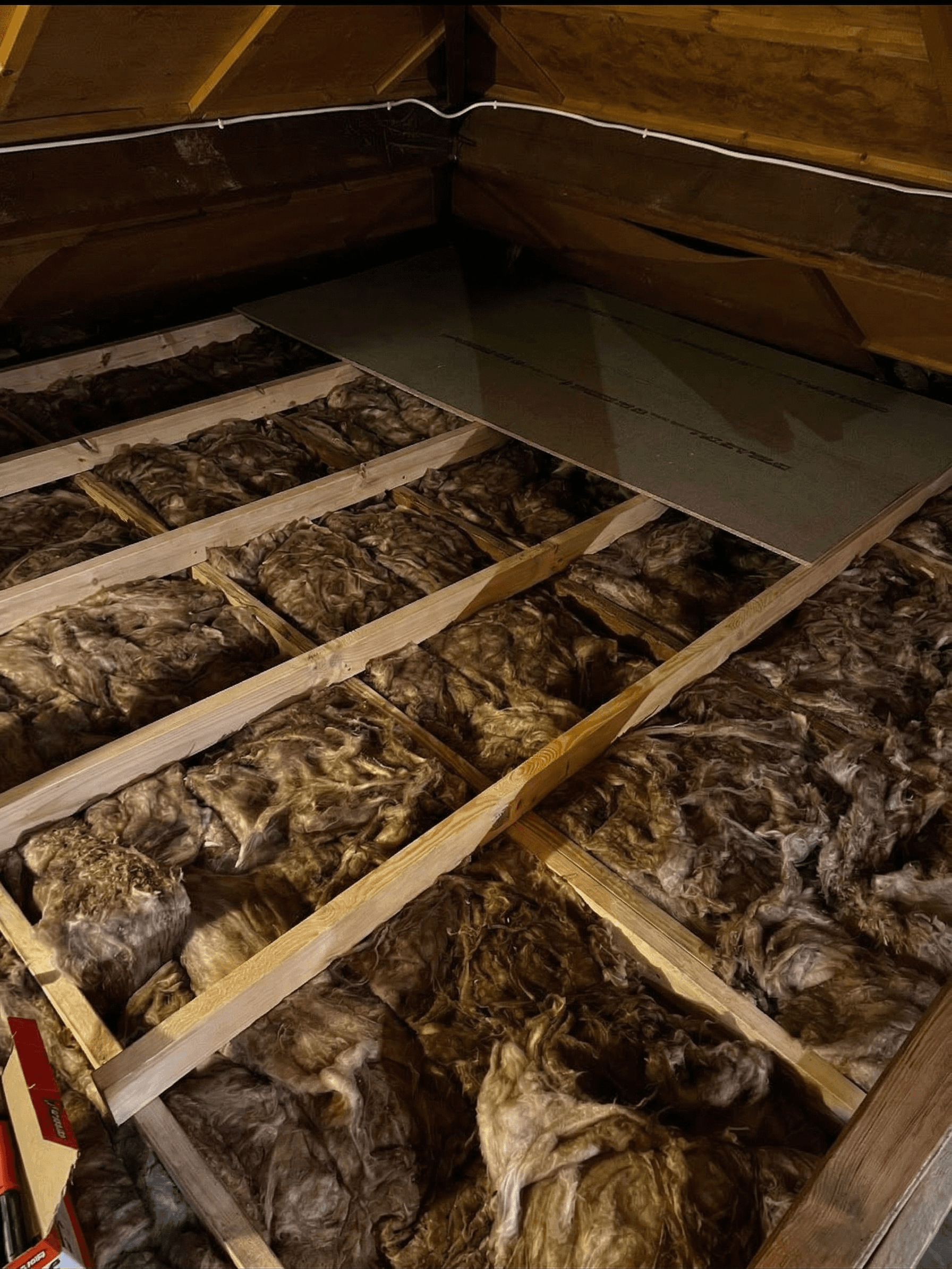
270mm Mineral Wool & Boarding
Loft insulation in Uxbridge
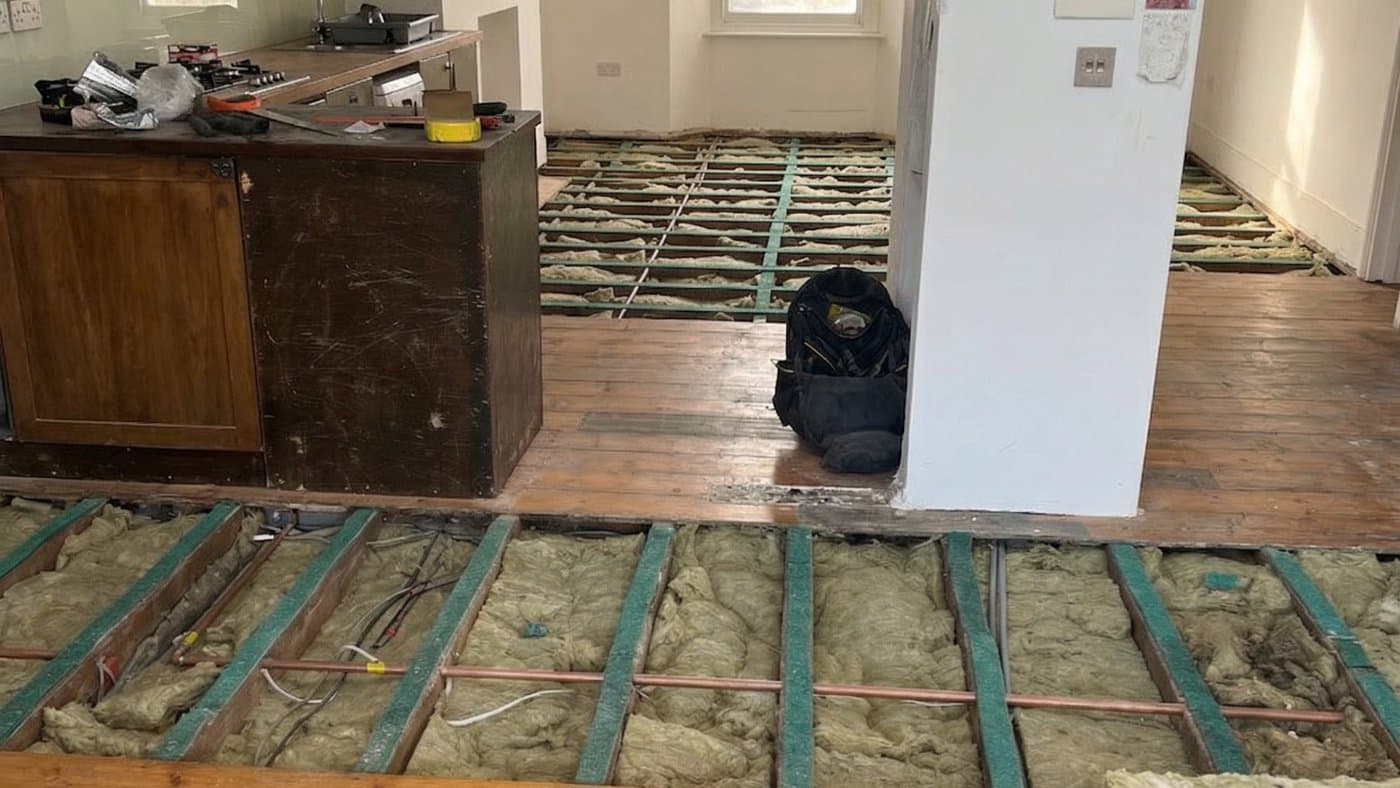
Suspended Floor Insulation
Mineral Wool in Dulwich
Is loft & roof insulation right for your home?
- Homes with under 270mm of existing loft insulation (most pre-2000 builds)
- Cold lofts used for storage — quick, low-cost top-ups
- Converted or room-in-roof spaces needing rafter-line insulation
- Properties with flat-roof extensions losing heat
- Anyone wanting the fastest-payback measure to start with
A loft top-up is worth doing when:
- You have less than 270mm of mineral wool (measure it at a few points; it is often uneven).
- The old insulation is compressed under boards, patchy, or disturbed by past work.
- You want a storage area and need raised boarding so the insulation keeps its full depth.
Choose a rafter or room-in-roof system when:
- The loft is converted or you plan to use it as a room.
- Rooms in the roof are freezing in winter and too hot in summer.
Flat roofs on extensions are a separate job, best done when the roof is re-covered; see flat roof insulation.
Loft & Roof Insulation systems and materials
| Material | Use | Depth for about 0.16 W/m²K |
|---|---|---|
| Glass mineral wool roll | Cold loft, between and over joists | 270mm in total |
| Stone mineral wool roll | Cold loft where fire or sound matters | 270mm in total |
| PIR boards | Warm loft (rafters) and boarded floors | 150 to 180mm |
| Wood fibre | Period roofs that need to stay vapour-open | 200 to 300mm |
For most lofts the answer is glass mineral wool: about 100mm between the joists and a second layer of about 170mm laid across them, so the joists no longer act as cold bridges. We do not install spray foam; our guide to spray foam insulation problems explains why.
Products we install
Mineral Wool Rolls
Glass or stone woolThe tried-and-tested choice for loft floors. Easy to lay in multiple layers to hit current building regulation targets. Cost-effective at scale.
PIR Loft Boards
Polyisocyanurate foamRigid PIR boards for lofts where space is limited or a walkable surface is needed over existing insulation. Higher performance per mm than mineral wool.
PIR Between & Under Rafters
Polyisocyanurate foamTwo-layer PIR system between and below rafters for a warm roof. Widely used for loft conversions where the rafter void becomes habitable space.
STEICO Flex Wood Fibre
Flexible wood fibreFlexible wood fibre batts that friction-fit between joists or rafters. Excellent acoustic properties and fully breathable — suited to heritage buildings.
The mistakes that make loft & roof insulation fail
1. Boarding straight over the insulation
You cannot lay 270mm of mineral wool and board over it on 100mm joists: it compresses and loses much of its value. Raised loft legs keep the full depth under a storage deck.
2. Blocking the eaves
Insulation pushed into the eaves blocks the ventilation. Humid air cannot escape, condensation forms under the roof and timbers suffer. Leave a clear gap or fit eaves ventilation trays.
3. Forgetting the water tank and pipes
Once the loft is properly insulated it gets much colder. A cold water tank and its pipes need a jacket and lagging or they can freeze on the first hard frost.
4. Leaving the hatch bare
An uninsulated, undraughtproofed hatch is a hole in an otherwise warm ceiling. Insulate its top and fit a seal round the frame.
5. Covering downlighters
Many recessed downlighters must not be covered with insulation. Fit fire-rated covers first or change to sealed LED fittings.
How loft & roof insulation installation works
Free survey
We check existing depth, joist spacing, ventilation and whether the loft is storage or living space to recommend the right build-up.
Quote
A fixed written quote within 24 hours — most cold-loft jobs are quick and low-cost.
Installation
Old material cleared if needed, new insulation laid or rafter system built with correct ventilation; boarding refitted where required.
Sign-off & guarantee
Final inspection, TrustMark paperwork and written guarantee.
Step by step
- Survey. Existing depth, joist depth, services, water tank, downlighters, and any sign of condensation or rot.
- Preparation. Damaged or compressed insulation removed, eaves cleared, downlighter covers fitted where needed.
- First layer between the joists at full thickness.
- Second layer across the joists to reach 270mm in total.
- Boarded area on raised legs, if you want storage.
- Hatch insulated and draughtproofed; tank and pipes lagged.
A straightforward top-up is often done in a day. Rafter and room-in-roof systems take several days depending on size and finishes.
Free survey and a fixed quote
Book a free, no-obligation survey and we'll send a clear, fixed written quote within 24 hours: PAS 2030:2023 certified and TrustMark registered, with all work installed by our own trained team.
Loft & Roof Insulation across London
Our team installs loft & roof insulation across London and the South-East. These local pages carry area-specific advice and nearby jobs. See every area we cover.
Loft & Roof Insulation FAQs
How much does loft insulation cost?
Do you install attic insulation across London?
What depth of loft insulation do I need?
Can I still use my loft for storage?
My loft is converted — what then?
Will it cause condensation?
Should I use spray foam in my loft?
How long does loft insulation last?
Is a top-up worth it if I already have 100mm?
Guides on loft & roof insulation
Detail on the questions homeowners ask us most.
Other insulation services
Last reviewed September 2026 by Stay Warm Insulation.
Get a free loft & roof insulation quote
Leave your details and we'll call you back within one working day to arrange a free survey.