
London & South-East England
Internal Wall Insulation Installers in London
Internal wall insulation upgrades solid walls from the inside, using insulated boards or a breathable system fitted against the external walls room by room. It is the go-to solution where the outside of the building can't be touched — listed buildings, homes in conservation areas, and flats where you only own part of the façade.
What internal wall insulation costs with us
£3,828 to £9,701
The middle half of 108 priced internal wall insulation quotes. Median £5,550.
Typical rate £130 to £140 per m² for the internal wall insulation itself.
Full price breakdown and real jobsFrom our quote book of 454 priced quotes. 0% VAT on insulation until 31 March 2027.
Internal Wall Insulation: key facts
- Best for listed buildings, conservation-area homes and flats where the exterior can't change.
- Typical cost £100–£140/m² — a single room from £1,800, a full 3-bed £8,000–£15,000.
- Build-ups add 50–100mm per external wall — a small floor-area trade-off.
- Breathable wood-fibre and SWIP systems protect older, vapour-open walls from moisture.
- Can be phased one room at a time, and you don't need to move out.
- PAS 2030:2023 certified, TrustMark registered, written system guarantee.
What is internal wall insulation?
Across areas like Richmond, Chiswick, Wandsworth and Tunbridge Wells, much of the period housing stock falls under conservation restrictions, which makes IWI the practical choice. The key decision is the system: rigid insulated plasterboard maximises thermal performance, while breathable wood-fibre and SWIP systems protect older, vapour-open construction from moisture problems.
We are PAS 2030:2023 and TrustMark certified IWI installers with our own in-house team — no subcontractors — and we specialise in heritage-sensitive installs that respect period fabric — managing reveals, skirtings, sockets and cornicing properly rather than just battening boards to a wall. We work across the whole of London: recent internal wall jobs range from Kilburn, Watford and Potters Bar in the north to Teddington, Carshalton and Hounslow in the south and west.
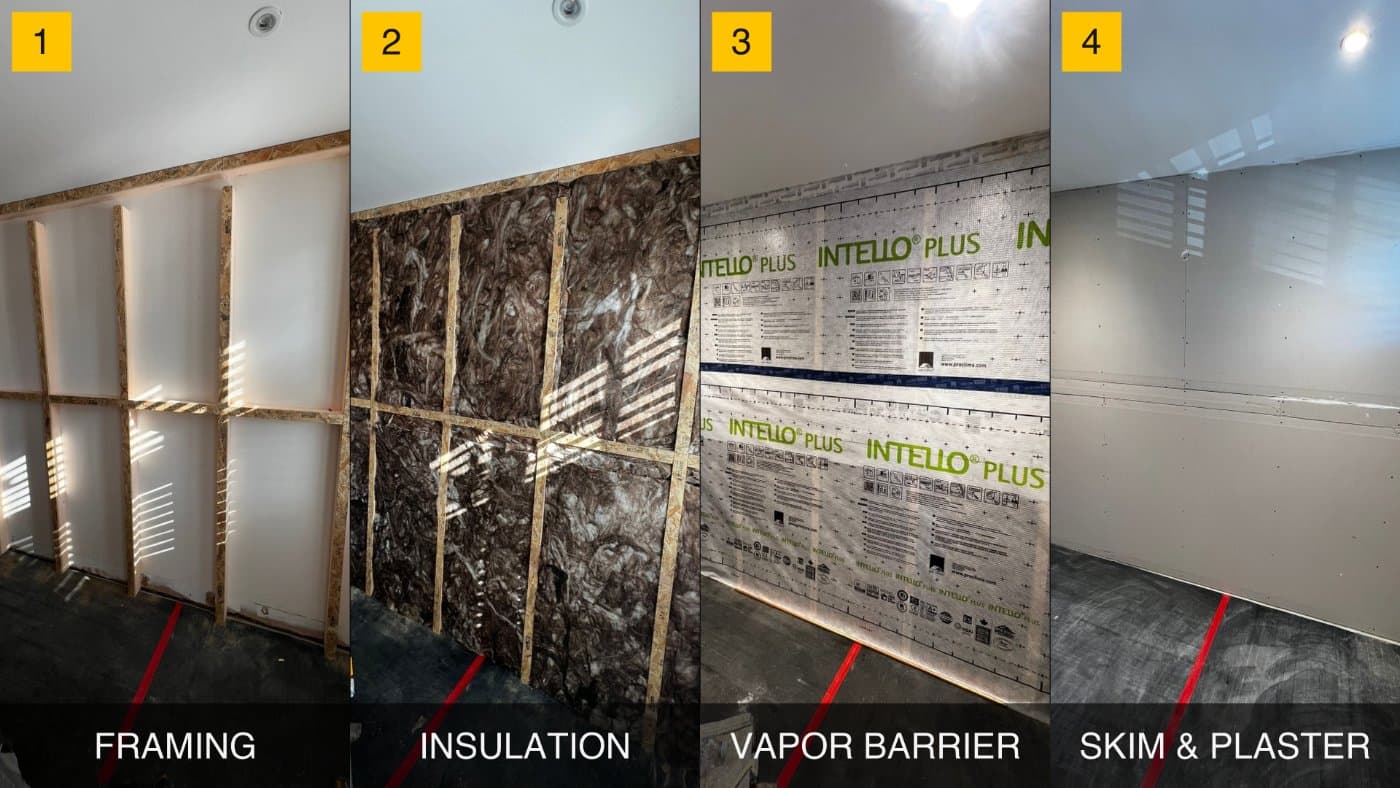
A typical IWI build-up runs, from the cold side to the warm side: the existing solid wall, an insulation layer (boards or an insulated stud system), an air and vapour control layer, and a plasterboard or plaster finish. Total thickness is usually 65 to 95mm; breathable wood-fibre build-ups can be thicker.
On paper the thermal effect matches external insulation. A 9-inch solid brick wall at about 2.1 W/m²K drops to around 0.30 W/m²K with 65 to 95mm of IWI. The rooms feel warmer and the condensation on cold walls stops.
The difference, and the reason IWI is the harder measure to get right, is that you insulate from the warm side. The masonry behind stays cold all winter. Any warm, humid room air that gets past the vapour control layer condenses on that cold wall and is trapped. Moisture control is what separates a good IWI job from a failed one.
Internal Wall Insulation cost in London
Prices from our own quote book and finished jobs in London and the South-East, not national averages. Every quote is free, fixed and itemised after a survey.
| Job type | Cost |
|---|---|
| Single roomGood way to start and spread cost | £1,800 – £4,000 |
| Typical 3-bed house (full)All external walls treated | £8,000 – £15,000 |
| Breathable wood-fibre systemPremium for heritage build-ups | +15–25% |
| Per m², system rateBoard or studs, finish and labour | £100 – £140 / m² |
| Per m², finished room all-inTwo measured single-room jobs incl. making good | £213 – £216 / m² |
What changes the price
- How much of the house. Most of our IWI jobs treat a few rooms rather than the whole house, which is why the median job is well below a full-house price.
- Empty or lived-in rooms. Empty rooms are quicker to work in than rooms we have to work around. See insulating while you live there.
- Services. Sockets, switches, radiators and pipes all move forward to the new wall face. Lots of surface cabling adds days.
- Finishing. Skirtings, architraves and cornice reinstatement are real joinery and plastering, covered in why good IWI is a finishing trade.
- The system. Breathable wood-fibre build-ups sit at the top of the range.
Insulation is zero-rated for VAT until 31 March 2027 (see 0% VAT on insulation). We work on privately funded jobs; for what grant help exists, read our insulation grants guide.
Every figure on this page comes from our quote book. The full dataset, with each finished job listed, is in what insulation really costs in London.
What real jobs actually cost
Anonymised prices from recent jobs our own team won and installed across London and the South-East. Every home differs — your fixed, itemised quote follows a free survey.
| When | Area | Work | Size | Price |
|---|---|---|---|---|
| June 2026 | East Dulwich (SE22) | Internal wall insulation | 13 m² | £2,700£216/m² |
| April 2026 | Crystal Palace (SE19) | Internal wall insulation | 14 m² | £2,980£213/m² |
| May 2025 | Watford (WD19) | Internal wall insulation | — | £5,120 |
| April 2025 | Shepherd's Bush (W12) | Internal wall insulation | — | £5,300 |
| January 2025 | Kilburn (NW6) | Internal wall insulation | — | £3,540 |
| January 2025 | Potters Bar (EN6) | Internal wall insulation | — | £5,420 |
| January 2025 | Carshalton (SM5) | Internal wall insulation | — | £3,070 |
| November 2024 | Leyton (E10) | Internal wall insulation | — | £3,900 |
Prices are real totals paid for the specific scope of each job (access, condition and finishes vary) — use them as honest reference points, not like-for-like quotes. Full cost guide
Recent internal wall insulation work
Real jobs completed by our own team across London and the South-East.
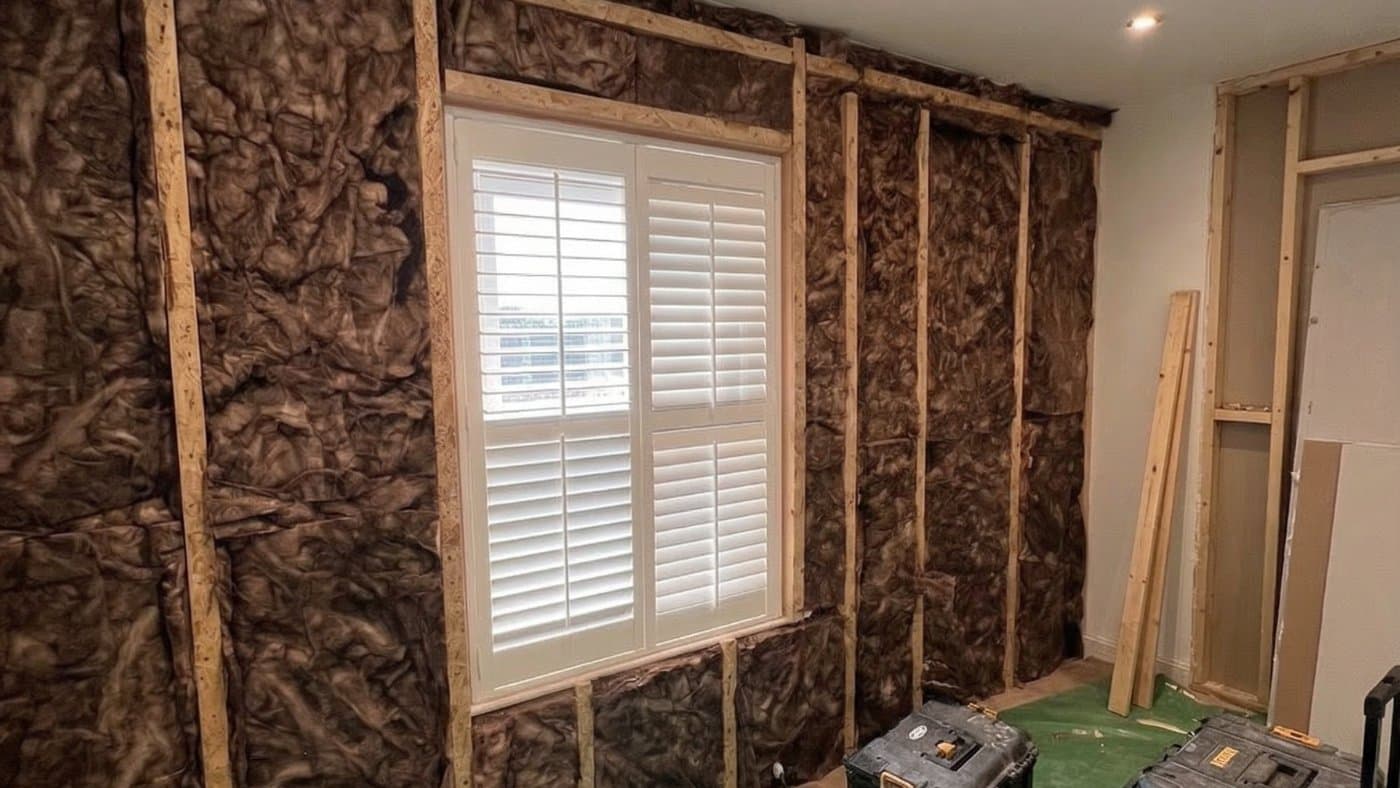
Internal Wall Insulation using SWIP IWI
SWIP IWI mid install in Croydon
Internal Wall Insulation
Internal wall Insulation in progress
Is internal wall insulation right for your home?
- Listed buildings and conservation-area homes where EWI isn't permitted
- Flats and maisonettes where you don't control the whole façade
- Solid-wall period homes where the brick frontage must be preserved
- Homeowners insulating a few rooms at a time rather than the whole house
- Properties needing breathable, moisture-open build-ups
Choose IWI when:
- You cannot change the outside: conservation areas, listed buildings, a terrace with a brick front that must stay, or a flat where you do not control the elevation.
- You want to insulate room by room, starting with the coldest rooms and spreading the cost.
- You are renovating inside anyway, so the disruption is already happening.
- The outside is in good condition and you do not want scaffold and render.
IWI is the wrong call when:
- The wall is actively damp. Fix penetrating or rising damp first, then insulate.
- You cannot lose room space. 65 to 95mm off each external wall adds up in small rooms.
- The room has fine cornicing, mouldings or panelling you want to keep. They have to come off and seldom go back the same.
- You want a quick job. IWI means stripping rooms to the brick, moving furniture and redecorating.
Weighing up inside against outside? Read external vs internal wall insulation, and for older houses insulating a period or listed home.
Internal Wall Insulation systems and materials
The four routes installers actually use, in the order we most often recommend them:
| System | Build-up | Best for | Cost band |
|---|---|---|---|
| SWIP thermally broken stud system | 65 to 95mm | Most solid-wall homes; engineered for them | ££ |
| PIR insulated plasterboard | 52.5 to 92.5mm | Quick installs, simple rooms | £ |
| Wood fibre with lime plaster | 80 to 160mm | Listed and very old houses | £££ |
| Mineral wool batten system | 100 to 150mm | Uneven walls, or where services run in the wall | ££ |
SWIP is what we install on most solid-wall homes, as a manufacturer-approved installer. Its composite EcoStuds insulate instead of cold-bridging like timber or metal studs, with water-repellent mineral wool between them and a taped vapour control membrane on the warm side. The build-up is BBA certified as one tested system and carries a 25-year system guarantee. See our SWIP internal wall insulation guide.
PIR insulated plasterboard is the lower-cost option with a thinner build-up; the vapour detail at junctions is less forgiving. Wood fibre with lime plaster keeps the whole wall vapour-open, so moisture that gets in can dry out again: essential on many pre-1850 and listed homes (see breathable wall insulation). Batten systems suit walls too uneven to bond to. The three board types are compared in PIR vs wood fibre vs insulated plasterboard.
Products we install
SWIP IWI System
Thermally broken stud IWI systemA BBA-certified internal wall insulation system built on thermally broken composite studs with mineral wool infill and a sealed vapour control layer, backed by a 25-year system guarantee. We install it as a manufacturer-approved installer.
PIR Insulated Boards
Polyisocyanurate foamHigh-performance rigid PIR boards that achieve excellent U-values in a slimmer profile than mineral wool alternatives — useful where internal space is at a premium.
PIR Insulated Plasterboard
PIR + plasterboard laminateAll-in-one insulation and plasterboard for ceilings and dot-and-dab wall applications. Single-fix solution minimising on-site steps.
The mistakes that make internal wall insulation fail
Failed IWI jobs almost always show one of these five faults.
1. Gaps in the vapour control
Gaps at sockets, junctions and pipes let warm humid air reach the cold wall behind the insulation. Within two or three winters mould can grow where nobody sees it. See airtightness and vapour membranes.
2. Window reveals left bare
Reveals are thermal weak points. If they are not insulated with at least 25 to 30mm of board, they stay cold and condensation forms round the frame. We insulate reveals as part of the system; see window reveals and sills.
3. Boarding over a damp wall
A wall that has been damp for a century seals its moisture in when closed-cell board goes over it. We damp-test walls before we specify, and treat the cause or choose a breathable system when the readings say so.
4. The floor junction
On a suspended timber floor, cold air from the void can rise behind the new wall. Insulating the floor at the same time closes that route; see floor insulation.
5. No ventilation plan
IWI makes rooms more airtight. Without working extract fans in kitchens and bathrooms, humidity builds up. A ventilation check belongs in every IWI specification; see ventilation after insulating.
How internal wall insulation installation works
Free survey
We assess wall construction and moisture risk, measure each room, and recommend a rigid or breathable system to suit the building.
Specification & quote
A fixed written quote within 24 hours covering board type, finishes, electrical and joinery adjustments.
Installation
Rooms cleared and protected, boards fixed with correct vapour control, then taped, skimmed and made good ready for decoration.
Sign-off & guarantee
Final inspection, TrustMark lodgement and a written system guarantee.
Step by step, room by room
- Survey. Damp readings on every wall, services photographed, room order and any furniture moves agreed.
- Quote. Itemised: strip-out, system, installation, services, making good and waste.
- Strip-out. Skirtings and radiators off, sockets and switches moved onto extension boxes, plaster taken back where needed.
- Preparation. Loose brick repointed, surfaces cleaned, high spots taken off.
- Insulation. Studs or boards fixed, joints taped, the vapour control layer made continuous.
- Reveals and junctions. Window reveals, ceiling edge and floor junction detailed with the vapour layer carried through.
- Finish. Plasterboard or skim to a paint-ready surface.
- Reinstatement. Skirtings, sockets, switches and radiators refitted.
A typical terrace takes 2 to 3 weeks, room by room, and you can stay in the house. Durations for every measure are in how long insulation takes.
Free survey and a fixed quote
Book a free, no-obligation survey and we'll send a clear, fixed written quote within 24 hours: PAS 2030:2023 certified and TrustMark registered, with all work installed by our own trained team.
Internal Wall Insulation across London
Our team installs internal wall insulation across London and the South-East. These local pages carry area-specific advice and nearby jobs. See every area we cover.
Internal Wall Insulation FAQs
How much does internal wall insulation cost?
How much room will I lose?
Is IWI safe for old, solid walls?
Can I do it one room at a time?
Do I need to move out?
Do you cover north London?
Are you IWI installers or do you use subcontractors?
Can I install internal wall insulation myself?
What if I already have damp?
Can I keep my fireplace?
Guides on internal wall insulation
Detail on the questions homeowners ask us most.
- SWIP internal wall insulation
- External vs internal wall insulation
- PIR vs wood fibre vs insulated plasterboard
- Why good IWI is a finishing trade
- Breathable wall insulation
- Insulating around chimney breasts
- Insulating a Victorian terrace
- Insulating an ex-council flat
- What IWI really costs in London (real jobs)
Other insulation services
Last reviewed September 2026 by Stay Warm Insulation.
Get a free internal wall insulation quote
Leave your details and we'll call you back within one working day to arrange a free survey.